
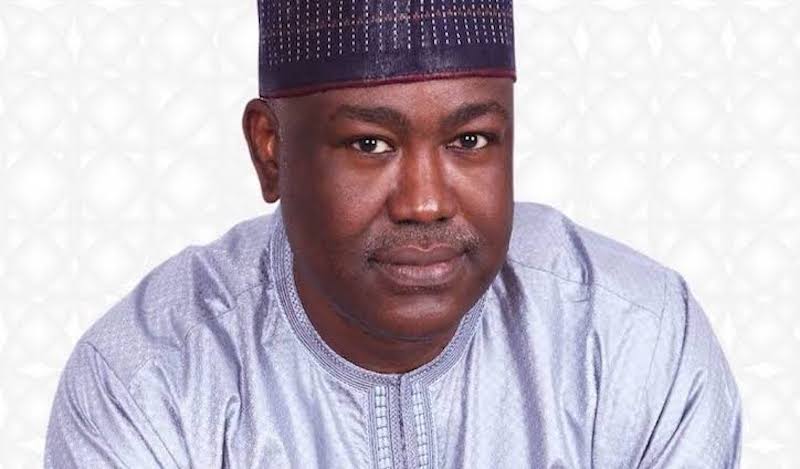
In a blunt, wake‑up call at a major democracy conference in Abuja, Gbenga Olawepo‑Hashim, PDP presidential hopeful, warned that Africa’s democratic experiment teeters on collapse — unless political leaders stop treating elections like a ritual and start delivering real economic justice and social welfare.
Speaking at the National Conference on the Future of Democracy in Nigeria, organized by the Peering Advocacy and Advancement Centre in Africa (PAACA), Olawepo‑Hashim didn’t sugarcoat it: democracy isn’t worth much to starving people. “Unless democracy translates into food on the table and better living conditions,” he said, “it will lose legitimacy.” [This Day]
He quoted a past head of state who reportedly said, “people will not eat democracy,” and leaned into that. When democracy fails to deliver hope, he argued, despair creeps in — and with it comes a longing for authoritarian fixes. “When democracy ceases to offer opportunity or hope, despair breeds nostalgia for authoritarianism,” Olawepo‑Hashim warned. [This Day]
Economy in Free Fall — And Democracy Is Paying the Price
He laid the blame squarely at the feet of Nigeria’s ruling APC, accusing them of wrecking the economy over ten years. According to him, Nigeria’s Gross Domestic Product has plunged from $574 billion in 2014 to less than $259 billion under APC rule. [source] That’s an astonishing collapse, he said — and evidence that political power without economic responsibility is meaningless.
On top of that, he chided the APC for unleashing fiscal recklessness: according to Olawepo‑Hashim, the national debt exploded from ₦12 trillion in 2014 to about ₦198 trillion today — a near 1,500% increase in just a decade. [Vanguard]
There’s also the security crisis. Hashim claims that under APC governance, the breakdown of law and order hasn’t just stalled development — it’s bleeding the country dry. [The Sun]
History’s Warning: Hungry Democracies Don’t Last
Olawepo‑Hashim is not just sounding alarms for Nigeria — he’s pointing at a systemic risk across Africa. Drawing on lessons from post-World War I Europe, he painted a grim picture: fragile democracies that failed to address economic hardship and social division collapsed, paving the way for dictators like Mussolini, Hitler, and Franco. [This Day]
His message is clear: if African governments keep producing hunger and insecurity instead of opportunity, a slide back into autocracy is not just possible — almost inevitable.
Institutions Aren’t Enough — We Need Integrity
Hashim didn’t hedge when it came to the institutions that supposedly underpin democracy — he argued that strong laws don’t save democracy; people do.
“Institutions are only as strong as the values of the individuals who manage them,” he said. [This Day] He reminded the audience that even in Nigeria’s darkest military days, some judges stood firm, protecting justice under pressure. And he pointed to Prof. Humphrey Nwosu, the former chairman of Nigeria’s now-defunct Electoral Commission, as a national hero: Nwosu, he said, defied political chess-play to deliver the fabled June 12, 1993 election. “Without Nwosu’s values, there would be no June 12 to remember,” he stressed. [This Day]
That kind of integrity, Hashim argues, must be rebuilt. Not just in courts or electoral bodies — everywhere.
Not Just Elections — Performance Matters
Olawepo‑Hashim didn’t mince words: democracy in Africa cannot survive on elections alone.
He urged Nigerian leaders to rebuild trust not through empty pledges, but through performance, fairness, and accountability. [source] In his closing remarks, he leaned into youth‑speak: “Our democracy must deliver, must make sense … like our youths would say, ‘make it make sense.’ We must make our democracy make sense.” [Independent]
Bigger Picture: It’s About Power, Not Just Politics
Beyond the conference, Hashim’s critique of the APC goes deeper. He’s repeatedly described the ruling party not as a serious political organization, but as a cult, lacking any real ideology, internal democracy, or long-term vision. [Independent] He warns that without genuine democratic structures, political parties become nothing more than vehicles for ambition — not champions of the people.
He’s also defended multiparty democracy as vital to Nigeria’s future. In his view, a system that accommodates different views isn’t a luxury — it’s the only way to guard against authoritarianism and promote unity. [The Nation]
Bottom Line
Olawepo‑Hashim’s message is loud and clear: African democracy is at a crossroads. If political elites don’t start making democracy work — not just talk about it — the risk of sliding back into dictatorship isn’t theoretical. It’s real.
His call to action is not empty rhetoric: it’s a demand that power be tethered to responsibility, that institutions be run by people of character, and that governance delivers more than just ballots.
Whether Nigeria’s leaders will heed that call remains to be seen. But one thing is clear — in Olawepo‑Hashim’s view, democracy’s future depends on whether it can feed its people, protect their dignity, and earn their trust.