
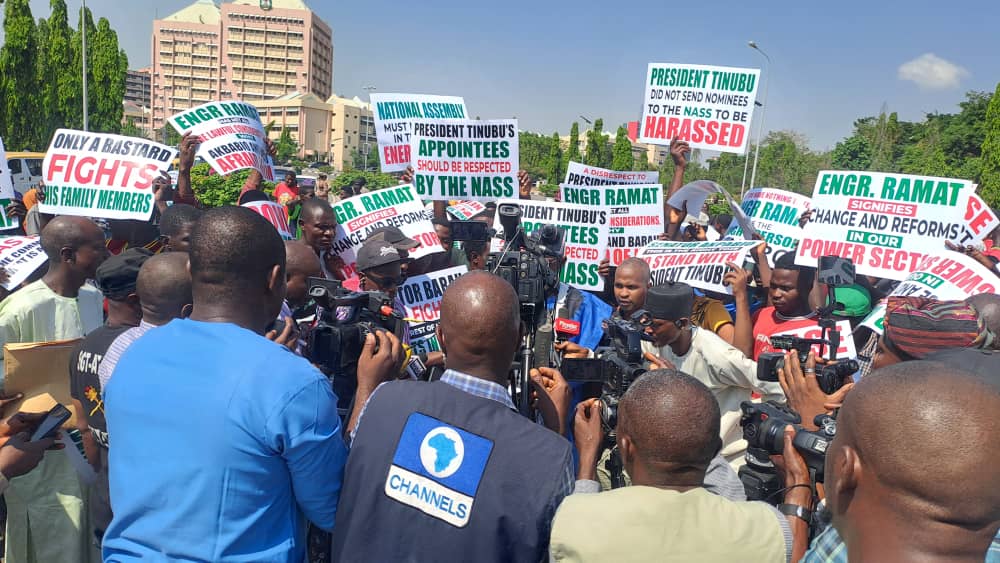
Abuja – The corridors of the National Assembly echoed with dissent on Tuesday as protesters — supporters of Abdullahi Garba Ramat, civil society activists, and rights groups — converged on the parliamentary complex in a show of force. Their demand: the Senate must confirm Ramat as the new chairman of the Nigerian Electricity Regulatory Commission (NERC) without any further dilly-dallying.
Clad in spirited chants and armed with placards reading “President Bola Tinubu Did Not Send Nominees to be Harassed” and “Ramat Represents Reform in Power Sector”, the demonstrators made their feelings clear. Their mobilisation followed the Senate’s abrupt decision last month to step down Ramat’s confirmation despite having vetted him through the Senate Committee on Power, chaired by Enyinnaya Abaribe. (Politics Nigeria, Vanguard)
Qualified Nominee, Stalled Confirmation
Back on August 7, 2025, President Tinubu nominated Engr. Abdullahi Garba Ramat as Chairman/CEO of NERC. (State House) According to filings, Ramat is an electrical engineer with a PhD in strategic management, among other credentials. On October 22, 2025, he, together with two other commissioner-nominees, faced the Senate Committee on Power for screening. (The Cable)
But after the screening, instead of progressing to confirmation, his name was placed on the Order Paper and then dropped — with the Senate citing “public and private complaints” as justification. (Daily Post)
Grounds for Protest, Charges of Sabotage
The protest lead group, Grassroots Initiative Concept, led by Ahmed Suleiman, said they had formally petitioned Tinubu and Senate President Godswill Akpabio. They claimed that entrenched interests were quietly working to derail what they described as a credible appointment. According to their statement, “It is surprising and deeply unsettling that Engr. Ramat’s confirmation was stepped down…” despite his proven qualifications. (Vanguard)
Another coalition of youth and civil society organisations echoed the call on November 10, 2025, pointing directly to the Senate leadership and accusing them of “constituting itself into a blockade” of necessary electricity-sector reform. They gave the Senate a 48-hour ultimatum to act—or face escalating nationwide protests. (The Cable)
Senate’s Counter-Move: Denial and Legal Posture
Meanwhile, the Senate’s camp is not sitting quietly. Senate spokesperson Yemi Adaramodu dismissed allegations of a US $10 million bribe to block Ramat’s confirmation as “baseless.” (Politics Nigeria) He maintained the step-down decision was rooted in complaints about suitability — not corruption or outside pressure. The Senate has also warned it would compel the former presidential aide who raised the bribe claims to substantiate them legally. (Politics Nigeria)
Why This Matters
Make no mistake: this is not a small spat over a post. The leadership of NERC matters — hugely. Nigeria’s power sector has for years been dogged by poor supply, skyrocketing tariffs and failed privatisations. Installing a reform-minded head is central to the Renewed Hope Agenda of the Tinubu administration. The coalition says the Senate delay “places personal political bargaining over national development.” (The Cable)
The weeks of inaction raise bigger questions: Who is pulling the strings behind the scenes? Are we handing merit over to manoeuvre? If credible, qualified persons can be blocked for reasons outside of competence, what hope does reform have?
Outlook
As of now, Ramat’s nomination remains suspended. The Senate has not scheduled the next step for his confirmation. At the same time, public frustration is rising: every blackout, every higher tariff—they echo this bigger failure of governance.
The protesters have made themselves loud and visible. Whether the Senate responds swiftly or slowly could well define how the Tinubu administration is seen: as moving reforms or being tied in knots. Either way, the power sector is watching — and so is everyone else.