
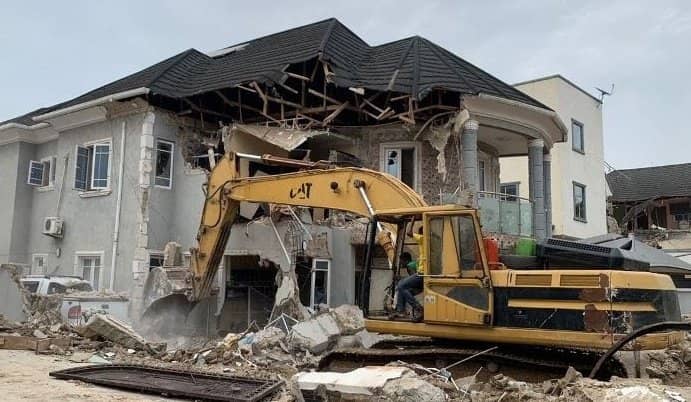
There’s serious alarm in Ibibio-land after the Mboho Mkparawa Ibibio (MMI) – the foremost socio-cultural body of the Ibibio people – saw their property in Lagos torn down. What should have been routine regeneration has turned into a full-blown identity fight.
According to a statement issued by the association’s International President, James Edet, the community centre at Rufai Close, off Rufai Street in Ojuelegba, Surulere, Lagos, was demolished by Lagos Metropolitan Area Transport Authority (LAMATA), acting under the umbrella of the Lagos State government. The building, they say, was properly registered (Title No. M07300) and had stood for decades as the hub of Ibibio cultural and civic life in the South-West. (Daily Post)
Property Was Registered — So Why the Demolition?
MMI asserts that the property spans 758.136 square metres and was fully cleared at the Lagos State Lands Registry. The demolition occurred despite “ongoing, peaceful negotiations” and allegedly without any formal agreement or compensation. According to Edet, the state government only offered N11 million for a property whose built structure was previously valued at over N250 million (more than fifteen years ago). (Daily Post)
In the community’s telling: “This is not just bricks being pulled down — it is our history, our pride, our identity being bulldozed,” the statement reads.
Accusations of Double Standards
MMI accuses the Lagos government of discrimination and dispossession. The association claims that while other ethnic groups freely own and operate properties in Ibibio-majority Akwa Ibom State, the reverse is not true – the Ibibio in Lagos are being marginalized. (Daily Post)
They are calling not for money, but for justice and restoration: a replacement property of equal or greater value, respect for their cultural base in Lagos, and a halt to further actions on the site until meaningful dialogue is initiated. (ThisDay)
The Stakes Are High
The building is not merely a brick-and-mortar asset; MMI presents it as a symbol of Ibibio presence and cultural resilience in Lagos. It has served for decades as a meeting place, a cultural hub, and a social service centre for the Ibibio diaspora in the South-West. Its demolition therefore resonates far beyond Lagos or Surulere; it echoes into identity politics, inter-ethnic relations, and state-community trust.
MMI’s statement explicitly warns that unless the Lagos and Akwa Ibom governments act — namely Babajide Sanwo-Olu (Governor of Lagos) and Umo Eno (Governor of Akwa Ibom) — “the risk of ethnic conflict between the states” could escalate. (Daily Post)
What’s the Lagos Angle?
So far, official response from Lagos remains limited in the public domain. The demolition is reported to have been carried out by or through LAMATA, which suggests transport- or infrastructure-driven action rather than purely urban renewal. Yet the community claims no formal notice, agreement, or offer of relocation-peace was presented.
Given Lagos’s aggressive redevelopment agenda, there are broader patterns of demolitions and property seizures in the state — though many of those involve encroachments on environmental rights of way. One example: earlier this year, 17 houses were demolished over river-bank encroachment in Lekki. (The Nation)
But this case differs: the community insists its property was properly documented and the action lacks the usual environmental justification.
A Community Mobilised
MMI is calling for intervention from multiple fronts: human rights organisations, cultural institutions, and the global Ibibio diaspora spanning the United States, Canada, United Kingdom, Europe, South Africa and across Nigeria. They declare: “Mboho Mkparawa Ibibio shall not be intimidated or broken. Our unity, pride and heritage remain indestructible.” (Daily Post)
They want immediate cessation of further action at the site, and meaningful dialogue with Lagos State Government to resolve the matter. They want a replacement of equal or greater value and a guarantee of their cultural/administrative base in Lagos.
Why This Matters
This is not just a “property dispute”. It strikes at the core of ethnic relations, culture, internal migration, and the rights of non-indigenes living in Lagos. Lagos may be a melting pot, but when a large ethnic group in a host city raises the alarm that their space is being erased, it touches on questions of dignity, belonging, and power.
It also poses a test for Lagos State: Is the government committed to fairness, due process and protection of community heritage? Or will infrastructure/asset-clearing interests override paperwork and cultural claims?
For Akwa Ibom and the Ibibio nation, the fight is equally existential: Will they allow their diaspora in Lagos to be pushed aside, or will this spark a broader mobilisation?
What Happens Next
- Whether Lagos State officially responds to these allegations of “unlawful demolition”.
- Whether MMI takes the matter to court — and whether the title registration holds up in a formal challenge.
- Whether compensation or replacement property negotiations commence — and how fast.
- Whether other ethnic communities in Lagos speak up, in solidarity or otherwise, and how that influences dynamics.
- Whether this incident sparks a broader discussion on indigene-settler rights, cultural centres and property law in Lagos.
We’re watching closely.