
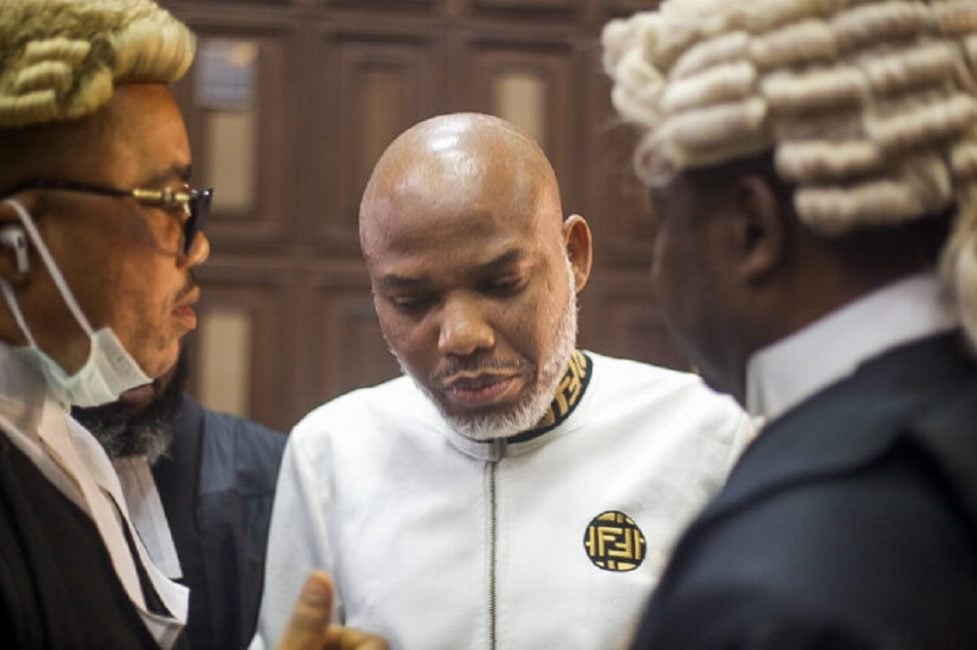
Abuja, Nigeria — After more than 10 years of legal wrangling, the terrorism trial of Nnamdi Kanu, leader of the Indigenous People of Biafra (IPOB), ended yesterday with a definitive and harsh verdict: life imprisonment. A Federal High Court in Abuja, under Justice James Omotosho, convicted him on all seven counts brought by the Federal Government.
The Long Road to Conviction
Kanu’s saga began in 2015, when he was first arrested in Lagos and arraigned in court. The back-and-forth trial went through four different judges before arriving at Omotosho, and suffered a major delay when Kanu jumped bail in 2017. He fled the country — following a military raid on his family home — and was eventually rearrested in Kenya in 2021, where he had remained in exile.
In 2022, then‑Judge Binta Nyako dismissed 8 out of 15 counts, narrowing the case to seven. The matter even went all the way to Nigeria’s Supreme Court in 2023, but was sent right back to the trial court.
What the Court Found
Yesterday’s judgment was thorough. Justice Omotosho held that the prosecution established all necessary elements of the terrorism charges. The government called five witnesses, submitted reams of documentary and video evidence, and quoted Kanu’s own fiery broadcasts.
Some of the damning moments:
- In one broadcast, Kanu allegedly threatened that Somalia would be nothing compared to what would happen to Nigeria if Biafra was not granted.
- In another, he declared, “in the next two weeks, the slaughter will begin … we are ready to die than be slaves… The army of Nigeria will die in Biafra land.”
- He was also quoted ordering a sit-at-home lockdown across South-east Nigeria, warning people not to leave their homes or risk being burned alive in shops.
The court deemed these broadcasts as tools of terror — intimidation of the public, a call to violence, incitement, and enforcement of his agenda via fear.
Omotosho further convicted him for:
- Leading a proscribed organization (IPOB) and urging its members to carry out violent attacks.
- Encouraging the killing of security agents, including police officers.
- Illegally importing a radio transmitter used for his “Radio Biafra” broadcasts.
The Sentence
- Life imprisonment for counts 1, 2, 4, 5, and 6.
- 20 years for count 3 (membership in IPOB).
- 5 years for count 7 (illegal importation of the transmitter).
- Sentences to run concurrently.
Instead of the death penalty (which the law allows), Omotosho opted for life imprisonment. He cited Christian principles of mercy — even though he described Kanu as cocky and unrepentant.
Special Custody Conditions
Recognizing the threat, Omotosho ruled that Kanu should be held in protective custody, but not in Kuje Prison, citing security risks. The court also barred him from using any digital device, unless monitored by the National Security Adviser (NSA) — a measure driven by his past use of technology to incite violence.
And that radio transmitter? It was forfeited to the Federal Government.
Reactions
Senator Enyinnaya Abaribe, speaking for many in the Igbo political class, slammed the verdict as a pre‑engineered plot. He claimed the case was “predetermined” and used against the South-East. Abaribe warned that justice in Nigeria, especially for the Igbo, often looks like exclusion masked by the façade of legal process.
On security, the 82 Division of the Nigerian Army dismissed rumors of a fresh sit-at-home order as fake and destabilizing. They assured full protection for innocent people in the South-East, deployed forces to prevent violence, and urged citizens to ignore panic-inducing messages.
What’s Next
Kanu’s camp says they will appeal. His former legal consultant, Alloy Ejimakor, described the verdict as unlawful and vowed to challenge it in the Court of Appeal.
This isn’t just another headline — it’s a high-stakes chapter in Nigeria’s volatile struggle over separatism, self-determination, and how the state defines terrorism. The sparks will fly from this one.