
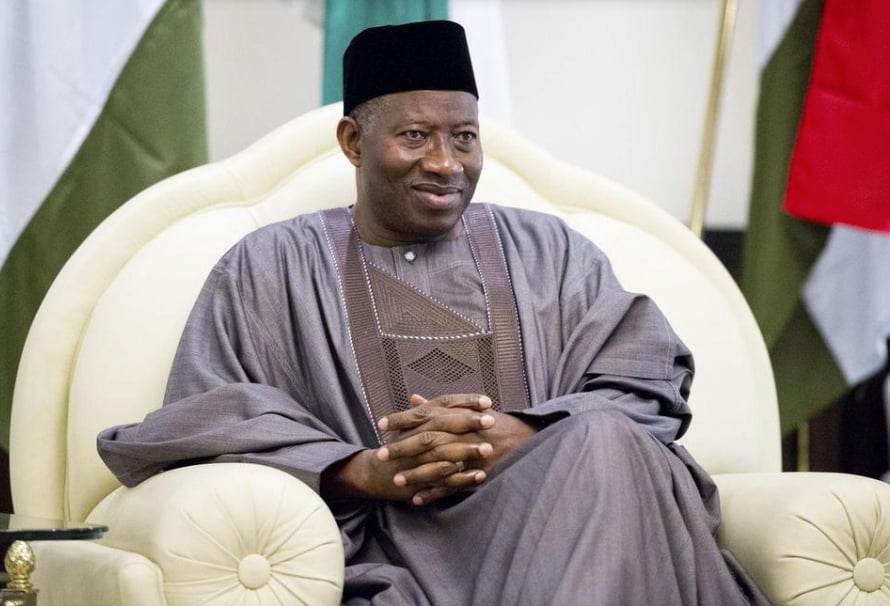
Former President Goodluck Jonathan has dropped a truth bomb many political actors in the Niger Delta have avoided for decades: the region didn’t fail because it lacked resources — it failed because leaders were too busy chasing power to pursue progress.
Jonathan’s comments, delivered in Abuja at the public presentation of The Hidden Treasures, a 202-page book by former Delta State governorship aspirant Chris Iyovwaye, cut directly to the root of the region’s long-running paralysis. Speaking through his Chief of Staff, Mike Oghiadomhe, the former president didn’t mince words — the Niger Delta has been crippled by weak political will, toxic rivalry, and personal ambition disguised as public service.
And he wasn’t the only one calling out the hypocrisy. Former SDP presidential candidate Adewole Adebayo and ex-Minister of Information Prof. Jerry Gana backed the assertion: the Niger Delta didn’t fall — it was dropped.
“Everybody Wanted Power — Nobody Wanted Progress”
Jonathan took listeners down memory lane — back to when he served as Bayelsa State deputy governor between 1999 and 2007. According to him, the region once attempted a unified development push through meetings of South-South governors and later an expanded forum including federal lawmakers. The vision was solid. The enthusiasm was high.
But the execution? Dead on arrival.
Why? Competition, he said — the greedy type.
“Action could not be taken because of competition for power and control. At one point, everybody in the Niger Delta wanted to be the vice president to an unknown president,” Jonathan recounted.
It was the Obasanjo era. The political permutation was simple: a Southerner had been President; the next would likely come from the North. So while the region drowned in perennial flooding, abandoned projects, and gas flares, its political elite were busy fighting for a slot in a presidency that didn’t even exist yet.
Jonathan’s message was brutal but accurate: Niger Delta leaders have been gambling for chairs in Abuja while their people sit on broken benches back home.
“Potential Doesn’t Build Roads”
Jonathan issued a warning to South-South governors — particularly those reviving regional cooperation platforms — that the Niger Delta no longer needs speeches; it needs bulldozers. Potential, he said, is useless without action.
“Deep inside there, we can have tonnes of gold, diamonds, and uranium. But it will remain zero until they are mined and brought out.”
He challenged the governors to stop theorizing and start building — investment vehicles, regional infrastructure frameworks, and credible plans that move beyond conferences.
Jonathan also reminded everyone of the region’s economic value. The Niger Delta sits on the country’s largest oil and gas reserves and has coastline advantages that could host Nigeria’s biggest seaport. Yet the region has no matching development to show for its natural wealth.
Adebayo: “It’s Impossible to Be Poor in a Region This Rich”
Adewole Adebayo didn’t sugarcoat anything either. He described the Niger Delta as “a mismanaged economic paradise” — a land so blessed that its continued poverty borders on criminal negligence.
“If you are from the Niger Delta, it will be an oxymoron to say you are poor,” he said, pointing to the region’s human and mineral wealth.
Adebayo also dropped a controversial but attention-grabbing comparison: he said the cumulative wealth buried in the Niger Delta is “18 times more than all U.S. productivity from 1776 to date.” While the number is more rhetorical than statistical, his point was clear — the region is too wealthy to be struggling.
He argued that leaders obsessed with rent-seeking, foreign patronage, and political showmanship are the real obstacle.
“A leadership consumed by appropriating surface wealth and farming out national resources for personal gain is not the shepherd God sent to this land.”
Gana: “NDDC Was Meant to Deliver Transformation — Not Primary Schools”
Prof. Jerry Gana, who helped conceptualize the Niger Delta Development Commission (NDDC) in 1999, said he is disappointed with how the commission turned out. The NDDC was designed as a development engine — a platform to transform the region with world-class infrastructure.
Instead, it gradually became famous for abandoned projects, minor constructions, and political patronage networks.
“I have not been impressed by the results of the commission,” Gana stated bluntly.
“The vision was to make the Niger Delta one of the most beautiful places in Nigeria.”
He urged the commission’s current managers to salvage what remains of the original dream.
Why the Niger Delta Is Still Bleeding
The Niger Delta — Nigeria’s oil-producing backbone — has spent more than half a century wrestling with environmental degradation, pollution, unemployment, and infrastructure decay. Oil spills, gas flaring, and poorly regulated extraction have suffocated agriculture and fishing — the region’s traditional livelihoods.
The NDDC, created in 2000 to reverse these setbacks, has faced repeated scandals. Multiple government-commissioned audits have indicted the agency for mismanagement, poor project quality, inflated contracts, and political interference. Billions in allocations remain unaccounted for.
Despite these failures, the expectations remain enormous. And so does the frustration.
A Region in Desperate Need of Courage — Not Committees
The loudest message from Abuja on Friday was simple: The Niger Delta does not lack resources. It lacks will.
Jonathan, Adebayo, and Gana all — from different angles — pierced the same wound. The region’s progress has been repeatedly sabotaged by leaders who treat public office like a stepping stone rather than a responsibility.
The book The Hidden Treasures may have triggered the conversation, but the sentiment is not new. What is new, however, is the urgency.
The Niger Delta’s clock is ticking. The oil economy is shifting. Global investment patterns are changing. And the region cannot afford another twenty years of political tug-of-war masquerading as development.
For once, the leaders must choose the region — not their ambition.