
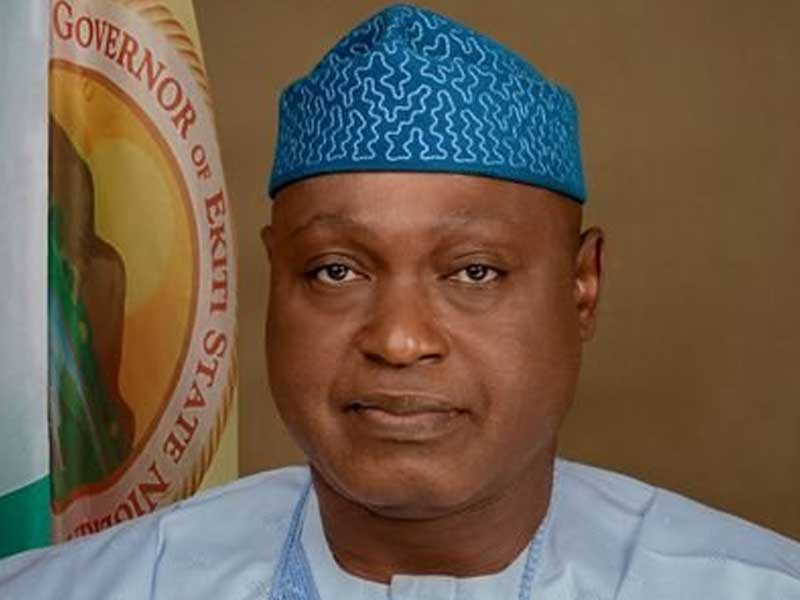
Ado-Ekiti, Nov 21, 2025 — As Governor Biodun Oyebanji marks his third year in office in Ekiti State, the verdict is mixed: genuine progress, but haunted by structural and political realities. The honeymoon may be over — but for some, the administration still delivers.
From Sentiment to Steel: The Man Behind the Office
Oyebanji’s rise carried weighty symbolism. He’s the first truly “home-grown” governor since 1999 — educated in Ekiti, rooted in its history. He once served as secretary of the very committee that created the state, and later as Personal Assistant to its first civilian governor, Niyi Adebayo. His political loyalty is ironclad; even as his party morphed, he held firm.
In his governing style, he’s gutted the pomp of the office. People close to government say he doesn’t hide from reality: he listens, he asks, he confronts grim truths. He’s not the untouchable governor; he’s the man in the trenches — hands dirty, ears open.
Forging Unity — But Not Without Skeptics
One of Oyebanji’s early wins was political reconciliation. He reached across party lines. He brought in former governors. He made peace with opinion leaders. For the first time in a long while, Ekiti’s political class seems less fractured.
Critics, though, whisper: maybe he’s just scared of opposition. Maybe his generosity stems from a desire to keep everyone friendly. But to dismiss that as political cowardice is to ignore what many see as his genuine Omoluabi ethos — integrity, humility, service.
Continuity, Not Reinvention — The Airport and Infrastructure Gamble
Where Oyebanji scores big is continuity. He didn’t scrap Governor Kayode Fayemi’s legacy — he leaned into it. The state’s agro-allied airport is now one of his headline achievements. In October 2025, the Nigeria Civil Aviation Authority (NCAA) granted approval for daytime scheduled commercial flights, running under Visual Flight Rules (VFR) for an initial six-month window.
It isn’t yet a 24-hour, all-weather airport — but the government is working on an Instrument Landing System (ILS) to make that possible. Oyebanji called the permit a “major boost to the state’s economy,” citing agribusiness, tourism, and medical-tourism potential.
On the ground, the physical makeover is quietly serious. The 17-km Ring Road and a flyover bridge linking Ajilosun to Okeyinmi are under construction — projects the Works Commissioner promises will be ready before Oyebanji’s third anniversary. Once complete, travel from Ajilosun through Ijigbo to Old Garage and beyond could shrink dramatically, easing traffic, reviving neighborhoods, and improving business flow.
Security: Quiet Gains, Loud Questions
Oyebanji claims security is improving — but not everyone is ready to believe the hype.
On one hand, he recently met with security chiefs, cut short his leave, and pledged to scale up intelligence and surveillance. He has repeatedly called for more police deployment, particularly in rural areas, warning that gaps in security coverage leave communities exposed.
On the other, the narrative about crime reduction is uneven. There’s no sweeping data to confirm that violent crimes like kidnapping have vanished. Still, Oyebanji links progress to his agricultural agenda: he argues that opening up land for commercial farming — especially around Ikole and Ijesa-Isu — has provided economic opportunities and reduced kidnapping in those zones.
It’s a bold claim, and one that requires sustained scrutiny. If true, it’s a clever strategy: turn criminals into farmers. But if not, the security gaps remain glaring.
The Political Storm on the Horizon
Three years in, and the calm isn’t quite universal. A brewing political showdown looms over the APC’s 2026 governorship ticket. Sources close to the corridors of power say tension is building — cracks are forming.
Despite his ally-making, Oyebanji has not avoided criticism. Some allege that his outreach is merely tactical — a way to neutralize rivals. His critics want to see more than politicking; they want bold governance not just symbolic unity.
The Bottom Line
Oyebanji’s three-year journey reads like a carefully plotted play: loyalty, continuity, and quiet discipline. There are real wins: he didn’t abandon his predecessor’s infrastructure projects, he’s coaxed airline approval for the airport, and he’s pushing ambitious road works. Security is improving, though not yet bulletproof.
But the questions are real: Can his security gains survive without more radical reform? Will the airport become more than a daylight operation? And as the 2026 election looms, is unity his strategy or his weakness?
Ekiti is better in some ways than it was three years ago — but a hope tempered by reality might just be the fairest assessment.