
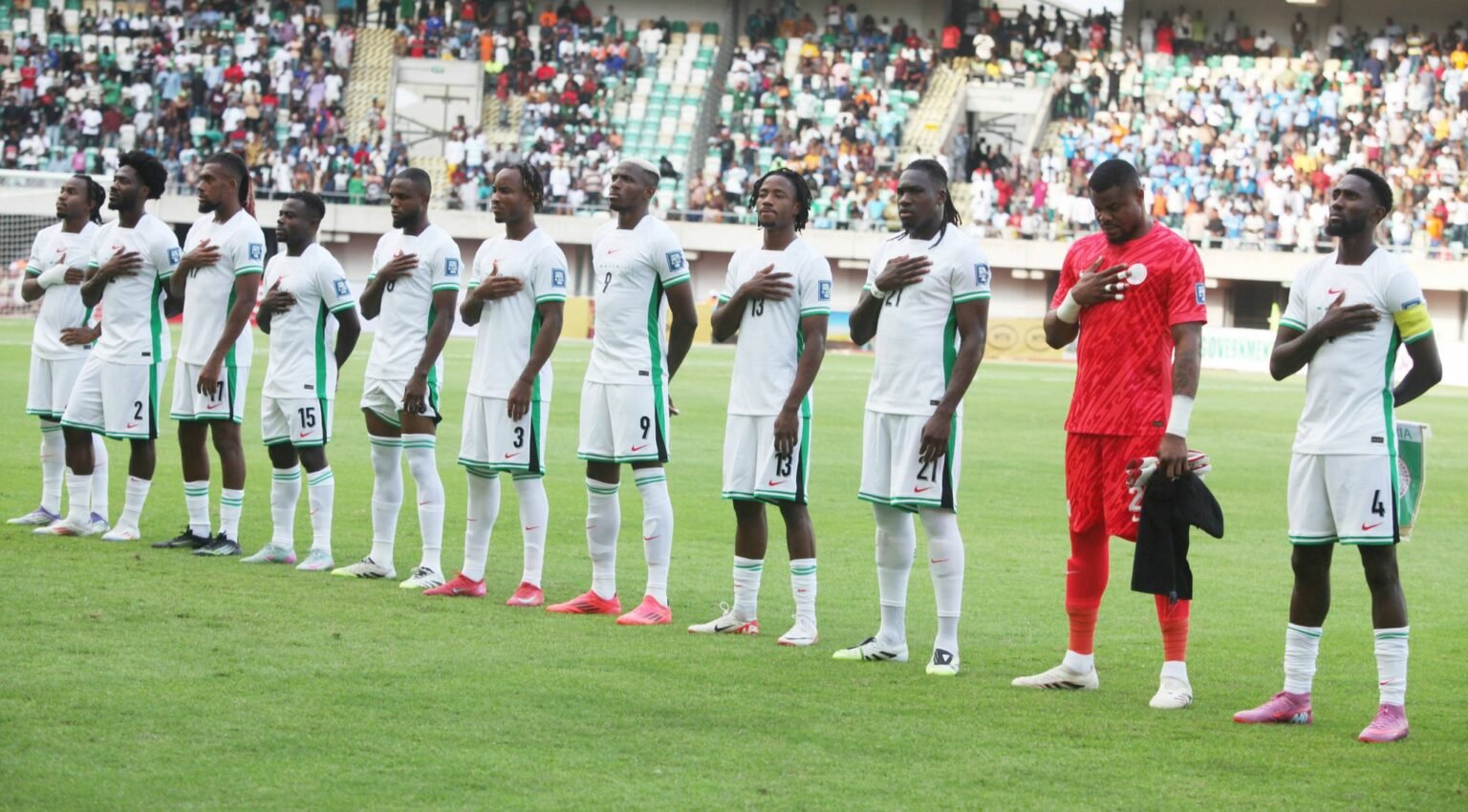
It is no longer news that The Super Eagles are down. Again. For the second consecutive World Cup, Nigeria will not hear its national anthem echo in a stadium on the world’s biggest football stage. The 2026 FIFA World Cup in the United States, Canada, and Mexico will be played without Africa’s once-proud, now-struggling giants.
It was a collapse nobody who followed Nigerian football closely should have been surprised by. A house divided against itself—debts to coaches, unpaid player bonuses stretching for years, and chronic mismanagement—arrived in Morocco, hoping miracles would replace competence. They didn’t.
By the numbers: Group C in the qualifiers had Nigeria, South Africa, Rwanda, Benin Republic, Zimbabwe, and Lesotho. Nigeria stumbled out of the gate: three draws, one defeat in the first four games, leaving them with three points from a possible twelve. José Peseiro, the Portuguese coach, was sacked. Finidi George briefly tried to resuscitate the team, only to step down after a loss to the Benin Cheetahs. Finally, Franco-Malien Éric Chelle arrived, brought a spark with a 2–0 victory over Rwanda in March, but momentum collapsed against Zimbabwe, conceding a last-minute equalizer at home.
In the final playoff against DR Congo in Rabat, Nigeria’s fleeting lead was erased, and penalties delivered the cruelest punch: 4–3. Fans watched in disbelief as Calvin Bassey, Moses Simon, and Semi Ajayi missed crucial kicks. DR Congo buried the decisive shot. The Super Eagles’ dream of World Cup redemption died in front of the nation.
It’s not just bad luck. It’s mismanagement, administrative chaos, and systemic neglect. Even FIFA point deductions and technicalities—like South Africa losing three points for fielding an ineligible player—couldn’t rescue Nigeria. Once hailed as the fifth-best team in the world after USA ’94, the Super Eagles now sit as a cautionary tale. Former captains like John Obi Mikel and Sunday Oliseh have called out the NFF for incompetence. This is a footballing emergency, not just a loss.
Chaos in Rabat
Nigeria struck early — Frank Onyeka’s long-range effort, deflected off a Congolese defender, gave them a 3rd-minute lead. But that glimmer of hope didn’t last: DR Congo drew level through Meschak Elia in the 32nd minute, punishing Nigeria’s sloppy midfield turnover.
At halftime, things got worse: Victor Osimhen limped off with a knock, replaced by Akor Adams. The substitution backfired. The midfield lost its grip. Iwobi looked lost. Ndidi offered nothing. And as the game chugged into extra time, Nigeria’s structure crumbled.
Then came the lottery — penalties. Calvin Bassey, Moses Simon, and Semi Ajayi all missed for Nigeria. DR Congo’s Chancel Mbemba stepped up and buried the decisive kick.
Administrative Chaos and Broken Systems
The post-match fallout has been brutal. Coach Éric Chelle, upset and frustrated, claimed DR Congo engaged in “voodoo” — maraboutage, he said — during the shootout. These are not just emotional outbursts; they reflect deeper wounds in Nigeria’s football psyche.
The NFF (Nigeria Football Federation) didn’t hide. In a public apology to President Bola Tinubu and millions of disillusioned fans, the Federation expressed “profound sadness” at the failure.
Former captains John Obi Mikel and Sunday Oliseh have sounded the alarm too. Mikel said the NFF board should resign if Nigeria fails again. Oliseh went further, calling the leadership incompetent and arguing that repeated World Cup failures amount to a massive regression for Nigerian football.
Even veterans in the game are joining the chorus. Sylvanus Okpala, a former player and coach, warned that the blame lies squarely with NFF, not Chelle. According to Okpala, if qualification fails, “everyone, including the NFF, has failed.”
The Qualification Journey
Two years ago, when the group draw was announced, many Nigerians felt confident. Group C included South Africa, Rwanda, Benin, Zimbabwe, and Lesotho — opponents Nigeria believed they could dominate. But what followed was anything but dominance:
- They drew their first three matches.
- They lost in Benin Republic, 2–1.
- Dead draws at home and away became routine.
José Peseiro was sacked, Finidi George briefly took over — then Chelle came in, raising hopes. Indeed, Nigeria finally tasted victory under Chelle in March, beating Rwanda 2–0 away in Kigali. But their momentum collapsed just a week later when Zimbabwe pegged them back at home with a 90th-minute equalizer.
If on-field collapse wasn’t enough, off-field mismanagement made things worse. South Africa was hit with a three-point deduction for fielding an ineligible player — initially a lifeline, ultimately a cruel twist.
Akwa Ibom: A Story of Rebirth
Yet, while Nigerian football crashes, another story is unfolding quietly in Akwa Ibom. On the very day the nation was digesting heartbreak in Morocco, Governor Umo Eno was signalling a rebirth in Uyo. The Ibom International Convention Centre, abandoned for 15 years, had its reconstruction officially flagged off, alongside the stalled Ibom 200-bedroom hotel project. Machinery hummed, architects hovered over blueprints, and banners declared ambition not dead. This was governance in action: bold, focused, and accountable.
“This is not just about concrete and steel,” Eno said, standing amidst cranes and scaffolding. “It is about positioning Akwa Ibom as the tourism hub of Nigeria.” With experience as a hotelier and former chairman of the State Hotels and Tourism Board, Eno knows that tourism is not a sector that thrives on slogans—it thrives on infrastructure. He is rebuilding what previous administrations abandoned, proving continuity is not a weakness but a power move.
From cranes to blueprints, the message was clear: leadership is about execution, not blame games. The Ibom Deep Seaport, the emerging ARISE Resort, and the Convention Centre are pieces of a broader strategy to pivot the state beyond oil, creating jobs, attracting investment, and reshaping perception.
Even in politics, Eno’s approach is unflinching. Local government chairmen, legislators, and traditional rulers lined up in praise, noting the governor’s rare ability to complete projects he didn’t start — a subtle rebuke to the national pattern of leaving ambition to rot. Economists have also weighed in: tourism is labor-intensive, value-generating, and sustainable — a stark contrast to the rot in Nigerian football management.
Two Sides of a Nation
One side collapsing under mismanagement, the other rising through competent governance. The Super Eagles are a painful mirror showing what happens when talent meets dysfunction. Akwa Ibom, meanwhile, is proof that vision, continuity, and accountability can turn decades of stagnation into momentum.
The lesson is brutal but clear. Nigerian football, left unchecked, bleeds. Leadership matters. When it fails, the nation pays. But the Akwa Ibom story reminds us that competent, focused leadership can reshape reality — one project, one state at a time.
The contrast could not be starker: while the Super Eagles’ ambitions crumbled in Morocco, cranes rose in Uyo. Nigeria’s football heartbreak is national; Akwa Ibom’s rebirth is local, but the underlying truth is universal: leadership decides outcomes.