
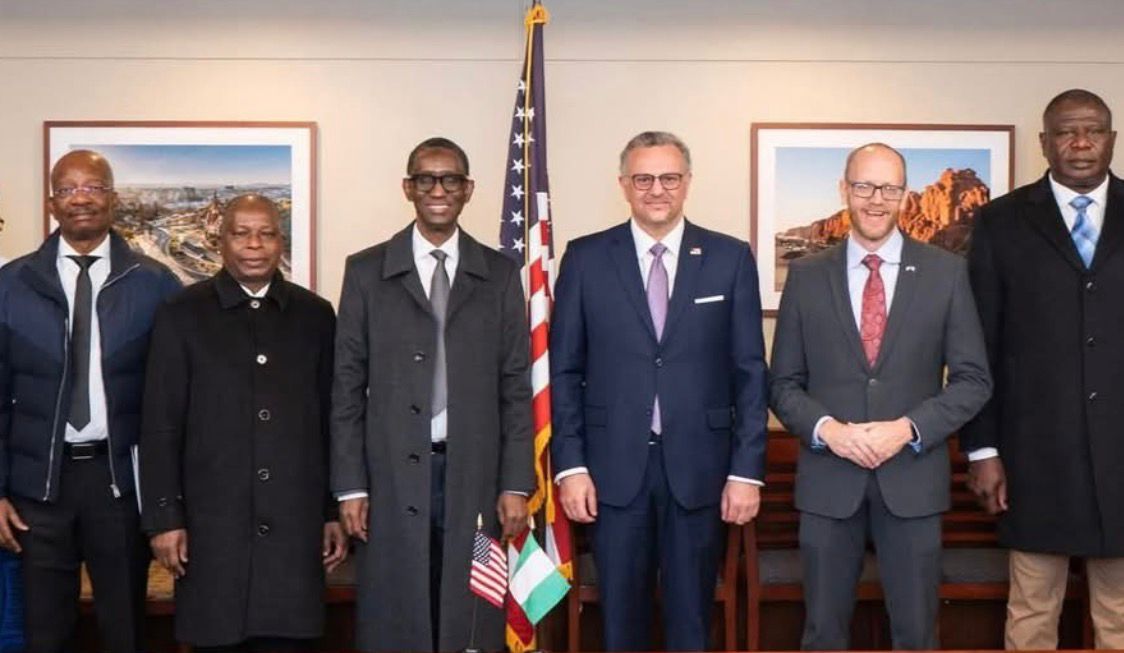
Nigeria is tightening its security belt — and this time, the presidency is putting weight behind it. President Bola Ahmed Tinubu has approved the Nigerian team for a new US–Nigeria Joint Working Group on security, a move insiders describe as “one of the sharpest diplomatic-security pivots of this administration.”
And he placed National Security Adviser Nuhu Ribadu at the helm.
Ribadu Takes Charge: Nigeria’s New Joint Security Engine With the US
According to officials close to the presidency, the committee is the product of high-level meetings in Washington DC, where Ribadu led a Nigerian delegation to negotiate expanded cooperation with the United States on terrorism, intelligence sharing, defence systems, and regional counter-insurgency.
Tinubu’s newly approved team is a mix of political heavyweights and the nation’s top security brains:
- Foreign Affairs Minister – Yusuf Maitama Tuggar
- Defence Minister – Mohammed Badaru Abubakar
- Interior Minister – Olubunmi Tunji-Ojo
- Humanitarian Affairs Minister – Bernard M. Doro
- Chief of Defence Staff – Gen. Olufemi Oluyede
- DG, NIA – Ambassador Mohammed Mohammed
- Inspector-General of Police – Kayode Egbetokun
- Secretariat – Idayat Hassan (ONSA) & Paul Alabi (Nigeria’s Embassy, US)
Tinubu’s instruction?
Work — and work fast.
No delays. No bureaucracy. Just results.
Matawalle Fights Back: “I Never Said Zamfara Security Won’t Work Without Me”
Meanwhile, Abuja heated up over the weekend after a viral online claim accused Minister of State for Defence, Bello Matawalle, of telling journalists that the new Zamfara security initiative “cannot work without him.”
He fired back immediately.
In a sharp rebuttal through his media adviser, Ahmad Dan Wudil, Matawalle said the statement was pure fiction — cooked up to drag his name into Zamfara’s political trenches.
His actual position? A full-bodied critique of Governor Dauda Lawal’s handling of security in the state.
Matawalle insisted that:
- The governor is isolating federal authorities.
- Security operations are being deployed without coordination.
- Stakeholders who know the terrain are being sidelined.
He warned that playing politics while citizens are under attack is reckless.
“Everything should not be politicised. This is the time all hands should be on deck,” he said.
He also called out media platforms pushing unverified statements, urging them to avoid becoming tools for “political mischief.”
Onaiyekan Warns Tinubu: “Don’t Hire 20,000 New Police — Fix the Ones You Have”
In Abuja, Cardinal John Onaiyekan took the mic at an international peace conference and delivered what many called an uncomfortable truth.
Nigeria doesn’t need 20,000 fresh policemen.
Nigeria needs to treat, equip, and deploy the ones it already has.
According to him, the current security personnel — if properly armed and freed from chores like carrying handbags for politicians’ spouses — can confront the nation’s attackers.
“With the police and soldiers we have now, we should be able to deal with them. Arm them well, treat them well, and they will work.”
He stressed urgency, warning that recruiting and training 20,000 officers could take a year — “and the country can be destroyed in one month.”
Onaiyekan also pushed for religious harmony, warning that while the world is pushing unity, Nigeria is drifting toward deeper internal divides.
Activist Shehu Sani added his voice, lamenting rising intolerance and shrinking freedom of speech, noting that arrests and social media witch-hunts are intimidating citizens into silence.
Army Chief to NDA: Build Officers Who Can Fight Today’s Wars
At Army Headquarters, Chief of Army Staff Lt. Gen. Waidi Shaibu told NDA Commandant Maj.-Gen. Oluyemi Olatoye to intensify training and rebuild the academy’s curriculum for a modern battlefield.
He wants:
- Stronger leadership conditioning
- High-end physical and night training
- AI integration
- Real combat readiness
- Stronger defence research and innovation
Shaibu emphasised that Nigeria must invest in its own defence industry and reduce dependence on foreign systems.
Olatoye pledged full commitment, calling the NDA the “factory” where tomorrow’s military leaders are forged.
PDP Visits Niger After Kidnapping — Calls Situation ‘Unfortunate and Heartbreaking’
The abduction of schoolchildren at St. Mary’s Catholic Church in Niger State has drawn national outrage.
A PDP delegation led by National Chairman Kabiru Tanimu Turaki visited Governor Mohammed Bago in Minna to offer sympathy and condemn the attack.
Turaki praised the state government’s efforts but stressed that no Nigerian child should live in fear of going to school.
He also said the PDP would continue supporting peace efforts across party lines.
Separately, PDP spokesperson Ini Ememobong criticised the APC-led federal government for “politicising security failures,” claiming banditry and kidnapping have grown into a trillion-naira criminal economy.
He urged the federal government to stop appealing to bandits and instead issue a clear, actionable directive for total security restoration.
Boss Mustapha: Diplomacy Saved Nigeria Before — It Can Work Again
Former SGF Boss Mustapha weighed in on the US placing Nigeria on its “Country of Particular Concern” list. He reminded journalists that this wasn’t the first time.
Nigeria, he said, survived it during Buhari’s administration through quiet diplomacy — not loud reactions.
His message to Tinubu:
Use global friendships. Engage behind closed doors. Don’t escalate.
Security Experts to Nigeria: Collaboration or Collapse
Private security experts also sounded the alarm: Nigeria cannot keep fighting insecurity in isolated pockets.
Retired Major-General Elvis Njoku, speaking for private security practitioners, said collaboration, tech-driven surveillance, and stronger community intelligence must become national policy.
They are rolling out:
- Drone surveillance
- AI monitoring
- Digital neighbourhood-watch systems
- Real-time threat escalation channels
Dr. Dauda Ageni reinforced the message, warning that Nigeria’s security architecture is too fragmented to withstand evolving threats.
Nigeria is at a pivotal moment. Tinubu is reconfiguring federal security machinery, religious leaders are pressing for urgency and unity, the military is rebuilding its training pipeline, political parties are condemning the rising violence, and experts are insisting on collaboration and innovation.
Nigeria has no option but to fight smarter — and fight together.