
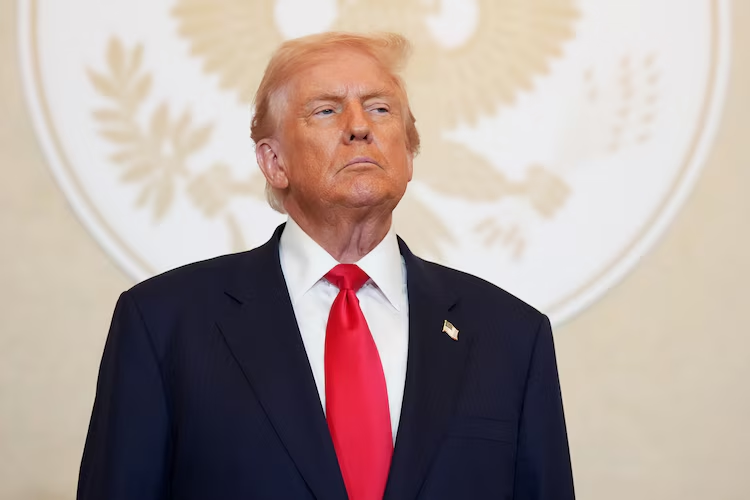
In a development that sounds more Hollywood thriller than sober diplomacy, Donald Trump has escalated the rhetoric on Nigeria—raising alarms, igniting conspiracy theories and forcing Nigeria’s leadership into a defensive crouch.
On November 1, 2025, the U.S. president claimed that Christians in Nigeria were under “existential threat” at the hands of Islamist extremists. He announced that the U.S. would pull all aid and had ordered the Pentagon (styled as the “Department of War” in his post) to prepare for possible military action against Nigeria if the government failed to stop the killings. (Washington Post)
He also designated Nigeria as a “Country of Particular Concern” (CPC) for religious-freedom violations—a label under U.S. law that signals very serious international human-rights allegations. (CBS News)
Nigeria’s government pushed back hard. President Bola Ahmed Tinubu declared that the characterisation of Nigeria as religiously intolerant “does not reflect our national reality” and reaffirmed that religious freedom is constitutionally guaranteed. (The Telegraph)
What happens next? It isn’t just about faith or persecution. The trigger has become the trigger for something much bigger.
Why Conspiracy Theories Are Going Off
Within hours of Trump’s post, Nigerian social-media channels began seeing a flood of wild theories—some half-baked, others chilling in their speculative depth. The gist of many: “Why is the U.S. suddenly pointing at Nigeria? What’s the deeper game?”
Here are the leading narratives:
1. Support for Palestine as the spark
In September 2025, Vice-President Kashim Shettima had addressed the UN General Assembly, saying that the people of Palestine should not be “collateral damage” in a quest for civilizational order—and that a two-state solution remains the “most dignified path”. Nigeria has recognised Palestine since 1988.
Many Nigerians believe the U.S. threat came because Nigeria backed Palestine and challenged Israel’s posture—thereby angering U.S.–Israel interests. The beats don’t align perfectly, but the narrative spread fast.
2. The Dangote Refinery power-shift theory
A viral WhatsApp message claimed the U.S. was furious with Nigeria for halting fuel imports thanks to the Dangote refinery—then recently exporting to the U.S.—leaving U.S. fuel exports wobbling.
Fact-check: Nigeria still imports most of its fuel from Europe (Belgium, Netherlands) rather than the U.S. in the last decade. (The Guardian Nigeria) Still, the story fits the mood: economic fear + national pride = fertile ground for conspiracy.
3. Minerals, mining rights and the “back-door grab” fear
Northern Nigeria holds gold and lithium reserves. Some Nigerians argue that an “attack in the name of Christian liberation” would hand mining rights to U.S. interests via pretend local warlords. As one commentator put it:
“After the bombing stops … the real terrorists … will come back … and start collaborating … for mining and resource rights.”
Analysts caution this is speculative—but the fear is real.
The Facts vs The Narrative
- Trump’s claim: Nigeria is “allowing” large-scale Christian killings and must act or face U.S. punitive measures. (CBS News)
- Nigeria’s response: Denial of targeted genocide claims, reaffirming that violence hits both Christians and Muslims and is driven by insurgents, communal conflict and other factors. (Washington Post)
- Data snapshot: Between Jan 2020 and Sept 2025, the ACLED dataset recorded 20,409 deaths in attacks against civilians in Nigeria. Of these, 317 were Christian-identity-based and 417 were Muslim-identity-based in incidents where religion was explicitly reported. (The Week)
- Security reality: Nigeria’s north has long been the theatre for jihadist violence from groups like Boko Haram and ISWAP, but victims and causes are mixed. Analysts avoid calling it a genocide based on religious identity alone. (Washington Post)
Bottom line: This is not your clean-cut “Christian genocide” scenario according to credible datasets—but the surface narrative of mass Christian persecution has huge traction.
Why Nigeria’s Government Finds It Risky
- Sovereignty under threat: Abuja has informed the U.S. via spokesperson Daniel Bwala that any foreign military action must respect Nigeria’s territorial integrity. (Reuters)
- Diplomatic and aid risk: Designation as CPC opens the door for sanctions, suspension of aid, and other punitive measures. (Washington Post)
- Middle-of-the-road violence: While Christians face attacks, Muslims are also heavy casualties. A narrative that singles out Christians as sole victims doesn’t match on-ground complexity. (Washington Post)
Why This Matters Beyond Faith
This episode strikes a chord for Nigeria on multiple fronts.
- Geopolitics: U.S.–Nigeria relations, global religious-freedom politics and proxy narratives for influence are entangled.
- Economics & resources: Oil, refining, minerals—all get wrapped into the noise of the threat.
- Domestic politics: Nigerian opposition and civil society may use this as ammo against the federal government for weak security and strategy.
- Social-media ecosystem: Conspiracies gain speed because they mix kernel truths (violence, insecurity) with raw suspicion.
What Nigerians Are Watching
- Will the U.S. really stage military action, or is this a twist of leverage and diplomacy?
- How will Nigeria respond—tough stance, negotiations, defiance or cooperation?
- Will converging conspiracy narratives (fuel economics, minerals, Palestine solidarity) intensify domestic unrest?
- How will faith communities react—will Christian victims amplify the narrative of genocide, or will it spark broader calls for inclusion and national unity?
The situation is fluid. The mix of real violence, shaky statistics, brazen threats and social-media conspiracies means this story will continue to evolve—and it may ripple into global religious-freedom campaigns, U.S. foreign-policy shifts and Nigeria’s strategic alignments.