
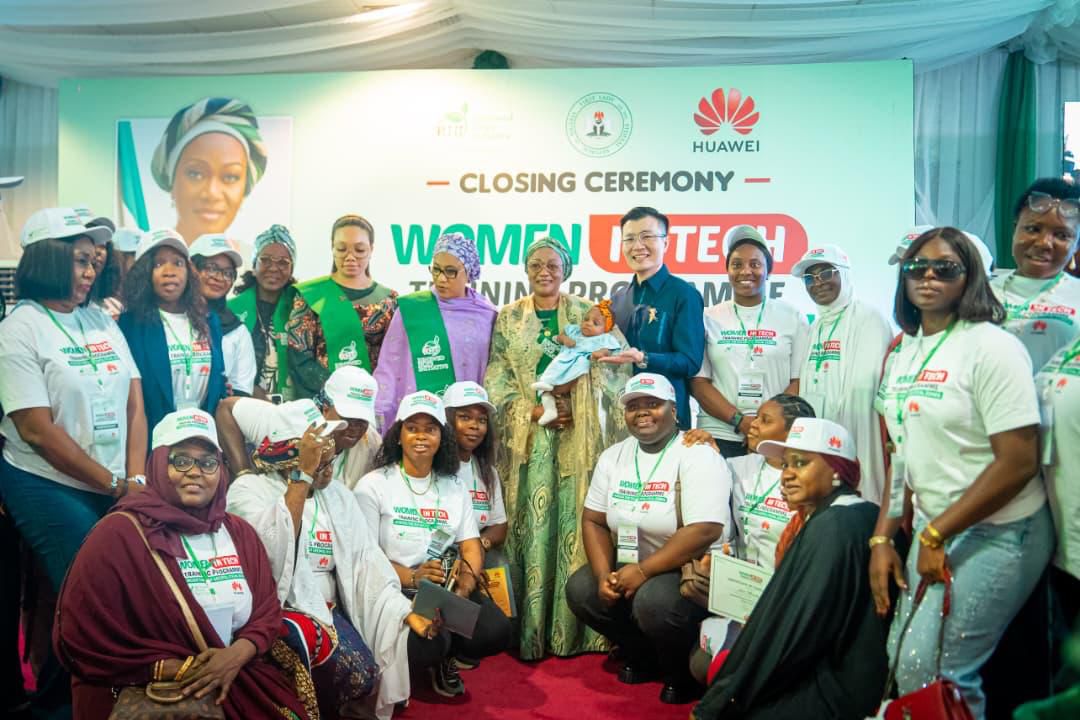
Abuja – In no uncertain terms, Nigeria’s First Lady, Oluremi Tinubu, made it clear during the closing ceremony of the Renewed Hope Initiative (RHI) and Huawei “Women in Tech” training programme that this wasn’t just a photo-op — the 300 women who completed the course must turn their new tech skills into community firepower.
The event, held in Abuja, marked the end of the six-month initiative (April to October 2024) which targeted female entrepreneurs from all six geopolitical zones. The aim: equip them with digital tools to scale businesses, participate in the digital economy and drive transformation in their communities. (Punch)
Bold goals, clear expectations
In a sharp, direct address, Tinubu laid out expectations: “Technology keeps changing. Your biggest strength is your ability to keep learning, evolving, and adapting to new trends.” She told the 300 participants to go beyond certificates — use your new skills to solve real problems in your communities, because true innovation is only valuable when it improves lives. (NAN News)
She didn’t leave them on their own. “You are part of a larger network — support one another and grow together,” she stressed. And she called on them to become mentors: reach young girls and other women who still think technology is not for them. (Punch)
It aligns with a bigger agenda
This initiative isn’t in isolation. The First Lady tied the training to the broader “Renewed Hope Agenda” of President Bola Tinubu — a policy drive aimed at inclusive growth, economic diversification, industrialisation and digital empowerment. (Western Post)
By equipping women with tech skills, the government is signalling that women are not side-actors — they are agents of change for families, communities and the nation. “When women are equipped with the right tools and knowledge, they become agents of change in their families, communities, and the nation at large,” the First Lady declared. (NAN News)
The voice of industry and regulation
From the private sector side, Chris Lu, Managing Director of Huawei Nigeria, didn’t mince words: “This programme went beyond training — empowering women to take their rightful place at the forefront of the global digital economy.” (Western Post)
Lu emphasised that technology is not a bonus — it’s a necessity in today’s world. “We know that when women rise, nations thrive,” he said. The graduates, he added, are now “ambassadors of digital innovation and change.” (NAN News)
Meanwhile, National Information Technology Development Agency (NITDA) Director-General Kashifu Abdullahi backed the sentiment: “When you empower a man, you empower an individual; when you empower a woman, you empower a nation.” He described the women present as more than graduates — they are emerging champions across homes and businesses. (Western Post)
Who exactly were these 300 women?
These women represent Nigeria’s diversity — from university students ready to jump into the digital economy, to business owners across sectors like agriculture, fashion, catering, retail, event management, and tech services. (NAN News)
The training itself was practical. It delivered digital and technological skill-sets tailored to the entrepreneurial realities of each woman’s business context. That means this is not theory; this is business meet tech, in action.
But resetting expectation — now the real work begins
This is where the tone shifts: Completion of a programme does not automatically equal transformation — the graduates know this, the First Lady made it clear. The real test starts now.
They must apply their skills. They must innovate. They must lift others. The “network” referenced is not a trophy — it’s a call to mutual growth. The challenge: don’t let the certificate become a shelf decoration. Let it become a tool.
Governments, partners and stakeholders have done their part — money, policy, training. Now the spotlight shifts to the individuals in that room, in those 300 seats. They carry expectation. They carry possibility.
They carry the message: technology is for everyone. Not some. Not “maybe”. Everyone.
The broader takeaway
This event signals more than 300 women trained; it signals a shift in narrative: female entrepreneurship + digital skills = national growth. Nigeria is saying: we will not be left behind in the digital age, and we will not leave half our population on the sidelines.
But if the words stay at the podium, if the training ends at the ceremony, then this becomes another nice headline without follow-through. The First Lady’s tone left no room for complacency. Harness the skills. Mentor others. Build something. Make lives better.
This is a news report of a moment that could pivot outcomes — but only if action follows words.