
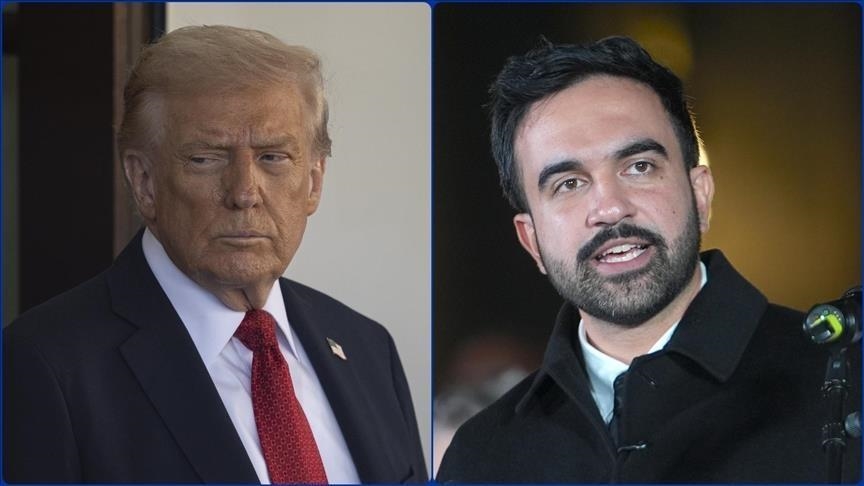
NEW YORK – The drama did not begin when Zohran Mamdani was declared the winner of the 2025 New York City mayoral race. It started earlier—when Donald Trump, in full campaign-mode, announced that a vote for Mamdani would invite retaliation. And now that Mamdani has prevailed, the question is: will Trump deliver on the threat, and can he legally?
On 3 November 2025, President Trump posted on Truth Social:
“If Communist Candidate Zohran Mamdani wins the Election for Mayor of New York City, it is highly unlikely that I will be contributing Federal Funds, other than the very minimum as required…”
(Source: The Guardian)
In an earlier “60 Minutes” interview he said:
“It’s gonna be hard for me as the president to give a lot of money to New York, because if you have a communist running New York, all you’re doing is wasting the money you’re sending there.”
(Source: Al Jazeera)
He labelled Mamdani a “communist” — though Mamdani calls himself a democratic socialist. (The Guardian)
Why It Matters
Mamdani, aged 34, won the 4 Nov 2025 mayoral election with about 50.4 % of the vote, defeating former governor Andrew Cuomo (41.6 %) and Republican Curtis Sliwa (7.1 %). He’ll be New York City’s first Muslim mayor, first of South Asian descent, and the youngest in more than a century. (Al Jazeera)
Federal funds account for roughly 6.4 % of the city’s operating budget—about $7.4 billion for FY 2026. Those funds flow into housing, social services, and transit. (Al Jazeera)
So when Trump says “I won’t give money,” the city actually stands to feel a pinch—especially if that amounts to hundreds of millions of dollars in withheld support.
What Trump Can Do – and What He Can’t
Can he legally cut the funds? Short answer: Not unilaterally.
Legal experts say the presidency does not hold open-ended power to withhold funds already appropriated by Congress unless specific legal conditions apply. (Al Jazeera)
- Under the Impoundment Control Act (1974), the president’s ability to withhold funds is highly restricted.
- If funds are appropriated by Congress for a defined purpose, simply refusing to disburse because you dislike the mayor of a city is likely unconstitutional.
- In previous cases, the federal government attempted to cut anti-terror funding to New York because of its sanctuary status; a federal judge blocked that move, citing “arbitrary, capricious” decision-making. (Associated Press)
So what can he try?
- Withhold discretionary grants or shift priorities toward programs conditioned on compliance with federal directives.
- Create uncertainty or delay in program funding, which can impose real costs on the city even if ultimately overturned in court.
- Use political pressure: public threats may spook investors, agencies, or partners even before any money is cut.
What Mamdani Has in His Toolkit
Mamdani is not going into this fight unarmed. He and his allies are already mobilising. He’s pledged to “Trump-proof” New York. Some of his moves include:
- Vowing to challenge the federal government in court if troops are deployed to city streets or if funds are withheld. (The Guardian)
- Planning to make New York the strongest sanctuary city in the U.S., with heavy investment in immigration legal defence and data protections for undocumented residents.
- Forming an all-female executive transition team to set bold reforms early. (The Guardian)
What’s Likely to Happen – and When
- Trump’s threats are real, but immediate full-scale funding cuts are unlikely because of legal and institutional constraints.
- What is likely: A period of fiscal duress for NYC, as program funding comes under threat and the city must budget for uncertainty.
- Litigation is almost certain. If funds are withheld because of Mamdani’s politics or identity, the city will sue—and may win (as has happened before).
- Politically, the move fits Mamdani’s narrative: “Big money, big power, tried to shut me down. I won anyway.” His victory speech already framed it like that.
Why You Should Watch This
What plays out in New York is not just local politics. It’s about federal-city tension, the limits of presidential power, and what happens when a major city elects a leader strongly opposed by the president. If New York stumbles under fiscal pressure, the precedent will ripple to other cities. If it survives, it could reshape urban governance in America.
Bottom line: Trump has publicly declared war on New York’s incoming mayor. Whether he can actually stop the funds is contested—but he can certainly try. Mamdani knows the battleground is already set. The fight may begin when he takes office 1 January 2026—but its roots go right through this week’s election results.