
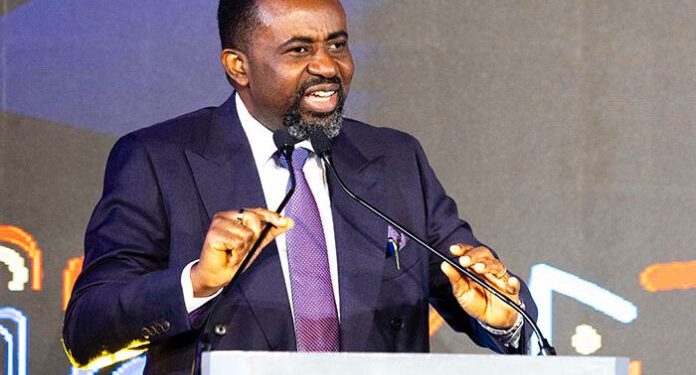
Accra — The voice of change has spoken loud and clear in Ghana’s fixed-income space. Bank of Ghana (BoG) Governor Johnson Pandit Asiama delivered a message that cannot be ignored: Ghana’s bond market is no longer just recovering — it is positioning itself to lead.
At the 10th anniversary celebration of the Ghana Fixed Income Market (GFIM) in Accra, Asiama gave this nation a moment of triumph. He pointed to GH¢214 billion in turnover on the GFIM so far in 2025 — proof that the domestic bond market is back in business. (MyJoyOnline)
From Crisis to Comeback
Remember 2023? The GFIM had slumped. Trading volumes plunged to GH¢98 billion amid the domestic debt-exchange programme (DDEP) and a shattered confidence in fiscal credibility. (MyJoyOnline) Before that, in 2022, volumes sat at roughly GH¢230 billion. (Ministry of Finance)
Now, Ghana is preaching a different story. At the event, Asiama highlighted that more than GH¢1 trillion has now been traded cumulatively since GFIM’s launch in 2015 — a clear signal that the market has not just recovered but is gaining muscle. (Citi Newsroom)
Lead Not Follow
Governor Asiama didn’t mince words. “Our goal is to make Ghana the reference point for transparency and innovation in African fixed-income markets. We have moved from rebuilding trust to leading by example,” he declared.
In other words: Ghana is raising its hand and saying, “Step aside, we’ve got this.” The BoG boss insists that Ghana aims to stand alongside the likes of Nigeria’s FMDQ Securities Exchange and Morocco’s Casablanca Finance City — markets that already define regional financial services hubs.
Regional Integration Ambition
The bold claim here is that GFIM will anchor capital-market integration in Africa under the umbrella of the African Continental Free Trade Area (AfCFTA) Financial Integration framework. That means Ghana is pitching itself as the node where cross-border fixed-income flows converge — not just a local player.
What Made the Turnaround Work
Asiama was transparent about the wrenching process. He distilled the journey into three lessons:
- Credibility is capital — without it, reform doesn’t last.
- Predictability brings confidence — markets crave stability before they chase return.
- Coordination is protection — fiscal and monetary alignment must walk hand in hand.
It wasn’t magic. It was disciplined policy. It was institutional alignment. It was market infrastructure improvements.
In his May 2025 keynote, Asiama revealed some hard numbers: Ghana’s cedi had appreciated 21.5 % year-to-date, inflation had eased from 23.8% at end-2024 to roughly 21.2% by April, and gross international reserves had climbed to about US$10.67 billion (~4.7 months of import cover). (Bank of Ghana)
More recently, in November 2025, he reiterated that inflation had dropped to 8% (a single-digit rate for the first time in years), reserves reached about US$11 billion (≈4.8 months cover), and the cedi had appreciated over 34% year-to-date. (Graphic Online)
What This Means for GFIM
With renewed credibility and trading momentum, GFIM is banking on three big growth drivers over the next decade: depth, diversity, and digitalisation. That means: deeper market liquidity, more corporate issuances (not just government), and tech-enabled infrastructure.
As Asiama put it: “This anniversary is not just a celebration of a platform, but of partnership. Together, we can deepen markets, expand possibilities, and secure Ghana’s financial future.”
The Bigger Picture: A Continental Play
Ghana is casting a net beyond its borders. By positioning GFIM as a regional benchmark, Ghana is saying: We want the West African investor, the North African institution, the pan-African asset manager looking for a fixed-income hub to say: ‘Go to Accra.’
If Ghana pulls this off, the ripple effects are huge: capital-flow diversification, stronger regional monetary linkages, and less dependency on external financing.
What to Watch Going Forward
- Corporate bond market: Governor Asiama flagged the need to move beyond government-dominated issuances to private sector debt. The GSE and SEC will be under pressure to step up. (MyJoyOnline)
- Liquidity sustainment: Turning a year of GH¢214 billion into a multi-year trend will require consistent investor participation and macro-stability.
- Digital infrastructure: The GFIM’s mandate includes using modern trading rails and platforms — the “digitalisation” component must work for operational credibility.
- Transparency & governance: The catch-phrase “transparency and innovation” is more than marketing. Markets will judge by delivery.
- Regional integration mechanics: Ghana’s claim to become a regional anchor depends on actual seamless cross-border market access, not just lofty speeches.
Bottom Line
Ghana’s bond market is no longer limping. It has stood up. It is flexing. With GH¢214 billion in traded volume this year (to date) and institutional discipline restored, GFIM is signaling that Ghana intends to be a front-runner, not a follower. Whether the narrative holds remains to be seen — but the tone has changed.
And for Ghana, and for the wider African capital-markets ecosystem, that shift matters.