
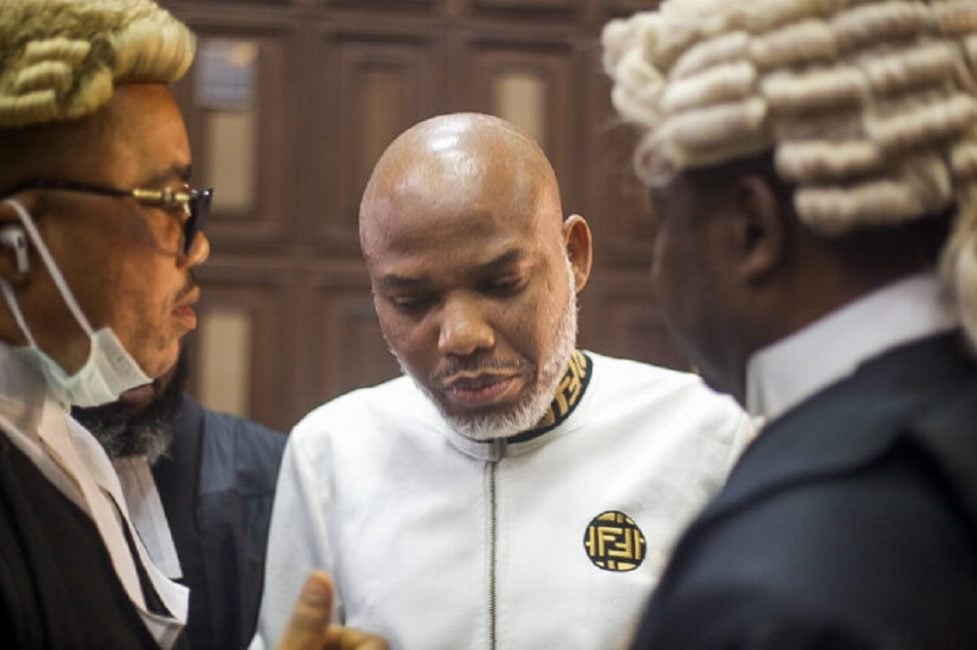
Abuja — In a move ripping open another chapter of the Nnamdi Kanu saga, tight security has been deployed around the Sokoto Custodial Centre following the arrival of the pro-Biafra leader who was recently sentenced to life imprisonment by a Federal High Court in Abuja.
The Verdict
On 20 November 2025, Kanu, leader of the armed-and-political movement Indigenous People of Biafra (IPOB), was convicted on seven terrorism-related counts. Justice James Omotosho held that the prosecution had proven its case, citing incitement, enforced sit-at-home orders, and allegations of bomb-making training as acts that fell squarely under terrorism.
Prosecutors had asked for the death penalty. The judge instead opted for life imprisonment and ordered that Kanu be moved to a “protective prison” rather than the more exposed Kuje facility in Abuja, pointing to past jailbreaks and heightened security risks.
The Transfer & Guard Build-Up
Within 24 hours of the sentencing, Kanu’s legal team announced that he had been moved from DSS custody to a correctional centre in Sokoto State. His lawyer, Aloy Ejimakor, criticised the move, arguing it places Kanu “so far away from his lawyers, family, loved ones and well-wishers.”
On arrival in Sokoto, the atmosphere shifted instantly. Residents around the custodial centre described a sudden surge in armed security. Soldiers and correctional officers positioned themselves at key points in and around the premises. Truckloads of uniformed personnel rolled in as dusk approached.
One eyewitness who requested anonymity said: “We saw soldiers entering in trucks this evening. The security here has never been this tight.”
Officials at the facility declined to publicly confirm that Kanu had arrived, but the security lockdown made it clear that something significant had changed inside those walls.
Why Sokoto?
The Federal High Court’s rationale is blunt: Sokoto offers more controlled security conditions and distance from previous jailbreak hotspots. Justice Omotosho had ruled that Kuje was unsuitable due to historic breaches and the level of risk associated with housing a high-profile inmate like Kanu.
Under the court’s directives, Kanu is barred from possessing electronic gadgets unless monitored by the Office of the National Security Adviser. Devices seized during trial were also forfeited to the Federal Government.
Strategically, Sokoto provides both geography and insulation — remote enough to deflect the daily media spotlight, and far from the Southeast where IPOB support is strongest.
Reactions: Family, Supporters, Government
Kanu’s wife, Uchechi Okwu-Kanu, confirmed publicly that her husband had arrived at the Sokoto prison. She also rebuked supporters who announced the transfer online before notifying her.
Activist and publisher Omoyele Sowore went further, describing the transfer as “secret” and warning that relocating Kanu to such a distant facility could expose him to danger.
Meanwhile, Minister of State for Foreign Affairs, Bianca Odumegwu-Ojukwu, called for restraint, especially within the Southeast. She described the development as “unexpected” but urged calm, emphasising that resolving the matter would require political, traditional, and religious engagement.
Opposition & Southeast Alarm Bells
Igbo socio-cultural groups wasted no time issuing responses. Ohanaeze Ndigbo condemned the life sentence as “a blow to justice” and warned it could further destabilise the region. President-General John Azuta-Mbata appealed directly to President Bola Tinubu to pursue a political solution.
The Movement for the Actualisation of the Sovereign State of Biafra (MASSOB) dismissed the judgment as politically motivated. The Ohanaeze Youth Wing also criticised the ruling, calling it an “assault on justice” and accusing the government of selective persecution.
Another group, the Igbo National Council, described the judgment as part of an “ethno-political war” and urged the President to grant Kanu a presidential pardon.
What Happens Next?
The move to Sokoto raises pressing questions: Is this a security decision or a tactical isolation? Will the transfer restrict his legal team’s ability to prepare further action? Can this step cool tensions or will it sharpen the divide in an already sensitive climate?
For now, the situation stands: Nnamdi Kanu has been sentenced, relocated under heavy guard, and placed in one of the country’s most remote custodial centres — and the national debate over the decision is only beginning.