
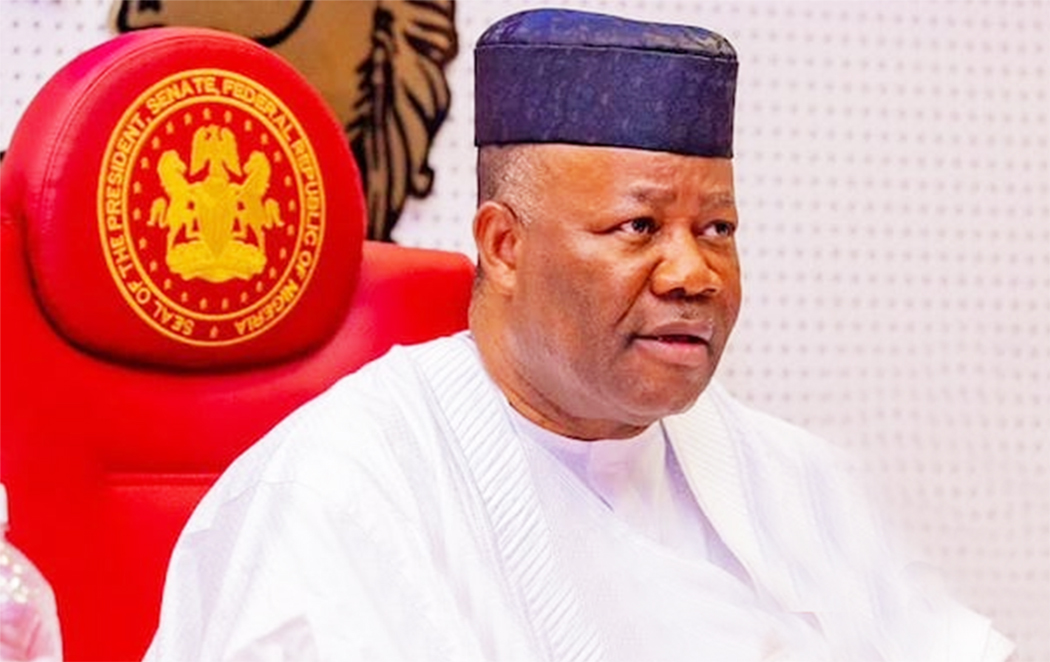
In a sharp rebuke of complacency and a clarion call to action, Godswill Akpabio, President of the Senate of Nigeria, challenged sports administrators on Sunday to stop treating grassroots football as an after-thought. His message: if Nigeria truly wants to reclaim its footballing glory, it must begin at the very bottom of the pyramid — the fields, the academies, the under 18 competitions.
Speaking at the opening ceremony of the 10th edition of the Senate President’s Under-18 Unity Cup held in Abuja, Akpabio did not mince words. The tournament, organised by the Grassroots Sports Federation (South-South) in partnership with the National Assembly, is pitched as more than just another youth competition — it’s a strategic push to rediscover and nurture the next wave of Nigerian football stars.
Grassroots = Future
Akpabio, represented at the event by Abdul Ahmed Ningi, Chairman of the Senate Committee on Sports Development, told the audience: “Sports, especially football, cannot grow if we neglect the grassroots. The young talents we see here today represent the future of Nigeria.” He reminded those in charge of sport development of the legacy they are supposed to protect: “In the past the likes of Stephen Keshi, Nwankwo Kanu, Jay-Jay Okocha, Daniel Amokachi, Victor Ikpeba and Tijani Babangida were all discovered through grassroots tournaments like this. We must revive that spirit.”
That bit of truth hits. When Nigeria was the powerhouse of African football, the production line worked. Now, it’s sputtering. With Akpabio signalling the system must be turned back on, the ball is in the administrators’ court.
Institutionalising Initiative
Akpabio announced that the Unity Cup will be institutionalised as an annual event — not a one-off. This move is crucial: you cannot discover and retain talent if the competition is ad-hoc. Instead, there must be consistency, structure, clear pathways to the national stage. The tournament will therefore be embedded into the calendar, with regular funding, support mechanisms and tracking of players beyond the week of competition.
He also commended President Bola Ahmed Tinubu for placing sports, and by extension national youth development, clearly on his radar. “President Tinubu has shown strong commitment to sports revival, and we must take advantage of the momentum. It should not be business as usual,” he added. The message is clear: for once, sports development is no longer the dusty corridor of government distractions — it’s a priority.
Unity, Platform, Development
The Grassroots Sports Federation earned praise from Akpabio for its partnership with the National Assembly in delivering this tournament. The Unity Cup is designed not just to unearth football talent — but to promote national unity, youth empowerment, and socio-economic development through sport. The design is holistic: players are not just drilled for goals and tackles, but seen as young Nigerians whose lives, careers and socio-economic paths matter.
The tournament features teams from across Nigeria’s six geo-political zones. Organisers said the participant make-up reflects national diversity and the broad scope of talent. (dailytrust.com)
On the Ground: Kick-Off
The 10th Unity Cup kicked off on November 10 and runs to November 17, 2024, in Abuja – at the Old Parade Ground, Garki. (leadership.ng) While original reporting claimed 21 teams (16 male + 5 female), more detailed sources suggest 13 teams were registered for this edition, representing six geo-political zones (two teams per zone plus a host team). (daybreak.ng) Either way, the message is clear: it’s national.
In the opening fixture, Young Stars FC Ikot Ekpene (Akwa Ibom) stunned Kaura Boys (Kebbi) 1-0 to get their campaign underway. Goal-scorer: Bakare Omobowale. (dailytrust.com)
Tournament Coordinator John Bassey Ekpenyong flagged the importance of the event: “This tournament promotes unity, sportsmanship and youth development… With Senator Akpabio’s leadership, it has the potential to become a flagship national event that empowers future generations.”
Why This Matters
It’s one thing for a powerful political figure to give speeches about talent development. It’s another to back it with institution-building. What makes this significant:
- Talent pipeline: Nigeria’s senior teams suffer because the path from age-group tournaments to the top is broken. Regular U-18 competitions restore that pipeline.
- Unity through sport: Bringing teams from diverse regions into one space creates bonds, understanding and shared ambition.
- Employment & opportunity: Youth football is not only about sport; it’s about giving young people something to aim for – a professional career, education, discipline. Akpabio mentioned employment creation among the objectives. (blueprint.ng)
- Visibility & momentum: By linking the tournament to his office and the National Assembly, Akpabio elevates the profile of youth football. If followed through, this can attract sponsors, media, and public interest.
The Catch (And What Now)
None of this will matter unless the administrators, state governments, private academies and local clubs take up the baton. Akpabio set the stage, but the performance will depend on continued investment, logistics, monitoring, and player-development systems. Without follow-up, these events become feel-good moments rather than transformation engines.
It is also crucial for the tournament to track outcomes: how many kids move into professional clubs, how many into national teams, how many benefit off the field. Without metrics, it’s another photo-op.
What to Watch
- Will the Unity Cup indeed become an annual and institutionalised fixture?
- Will states and clubs build feeder systems tied to the tournament?
- Will sponsors and media commit to youth football coverage and support?
- How many U-18 stars from the tournament get recruited into bigger clubs or national youth teams?
- Will the narrative of revival turn into actual revival (for Nigeria’s senior football fortunes)?
This is not just a football tournament. It is a litmus test. Can Nigeria rebuild its football greatness from its roots? The answer may well hinge on whether this moment becomes system-change or stays token. The players are on the pitch – now administrators must play their part.