
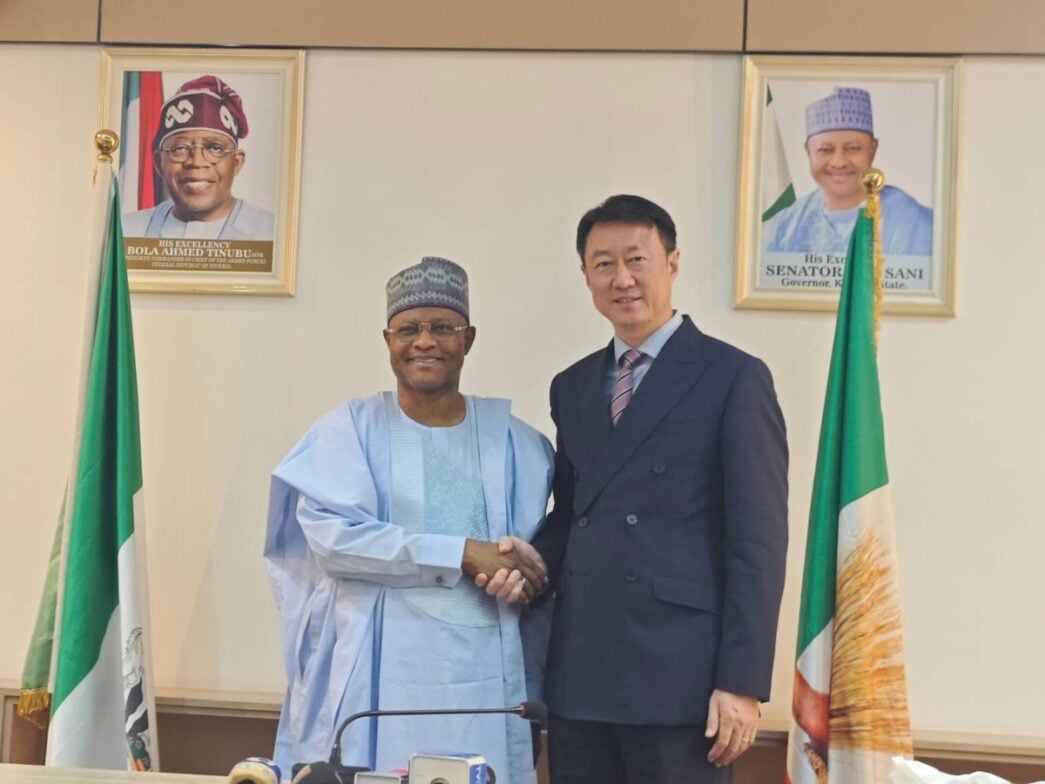
In a move that signals serious sharpening of China-Nigeria agro-ties, Uba Sani, Governor of Kaduna State, has confirmed that the pilot phase of a massive US $450 million poultry project — a joint venture between Nigeria and the People’s Republic of China — will launch in his state. The announcement came on Thursday when he hosted Yu Dunhai, Chinese Ambassador to Nigeria, and officials of the Nigeria–China Strategic Partnership (NCSP) at Sir Kashim Ibrahim House in Kaduna. (Guardian Nigeria)
According to the governor, this is not a mere photo-op. This is “a defining stride” toward positioning Kaduna as an agro-industrial heavyweight in Africa. “This visit is not merely another diplomatic courtesy, but a defining stride in our mission to attract transformative partnerships that reinforce Kaduna’s position as a continental centre for agricultural and industrial excellence,” he declared. (Guardian Nigeria)
What’s on the Table?
- The project is valued at US $450 million. (Guardian Nigeria)
- It covers a total land area of 10,000 hectares in Kaduna, with the state government allocating over 7,000 hectares already for immediate commencement. (Arise TV)
- Planting of maize and soybeans for poultry-feed production is included. (Guardian Nigeria)
- Employment targets: around 50,000 direct jobs and more than 300,000 indirect jobs across the value chain, summing up to more than 350,000 jobs. (Arise TV)
- Construction is slated to begin December 2025. (Guardian Nigeria)
- The investment is part of Nigeria’s wider Renewed Hope Infrastructure Fund (RHIF). (Guardian Nigeria)
Why Kaduna?
Governor Sani emphasised that agriculture contributes roughly 43 % of Nigeria’s GDP and employs over 60 % of its citizens — figures he cited to argue that the state is “leading” the national charge in agro-industrial advancement. (Guardian Nigeria) He extended thanks to Bola Tinubu for choosing Kaduna as the pilot location, framing it as validation of the state’s commitment and capacity to drive agricultural transformation.
From the Chinese side, Ambassador Yu Dunhai praised Kaduna’s stability, enabling environment and readiness to attract global investment — stating the region has set itself up as a preferred destination. (Arise TV)
NCSP’s Director-General, Joseph Tegbe, backed the praise with hard facts: the state’s rapid land allocation and approvals “for immediate commencement” as evidence of seriousness. (Guardian Nigeria)
Key Implications
- Food security boost: With local feed-stock production (maize, soy) integrated, the hope is substantial improvement in poultry output and reduced dependence on costly imports.
- Job creation: Tens of thousands of Nigerians (direct and indirect) stand to benefit — a potentially game-changing number in a country grappling with youth unemployment.
- Agro-industry pivot: More than farming, the project positions Kaduna (and Nigeria by extension) as a processing and manufacturing hub — higher-value industrial activity.
- China-Nigeria economic deepening: The deal illustrates how China is deepening its footprint in Nigeria’s agriculture sector and beyond.
- Political signalling: For the Tinubu administration, this is a high-profile win: infrastructure, jobs, foreign investment — all lines it needs to show progress on.
Watch-outs Worth Noting
- Implementation is scheduled to begin December 2025 — that’s still months away. Execution risks will loom large.
- Land-allocation is substantial, but 7,000 hectares is already approved; full 10,000 hectares are promised. Ensuring acquisition and land-rights remain uncontested will be critical.
- Scaling to 350,000 jobs is ambitious. Past mega-projects have over-promised wider indirect job numbers.
- The ability to supply reliable feed-stock, infrastructure (roads, power, logistics) and stability of the business environment will determine whether this becomes a story of success or a stalled headline.
What Now?
For Kaduna State and Nigeria, the clock now ticks from pilot-phase announcement to real boots-on-the-ground. The announcement is bold; the real test lies in execution. If the December 2025 timeline holds and the factories, farms and processing plants rise as planned, this could be a landmark in Nigeria’s agro-industrial evolution. If not — the headline might turn from promise to postponed.
One thing is clear: Kaduna has staked its claim as the country’s next big agriculture-industrial frontier. All eyes will be on how quickly and cleanly the promise transforms into output, jobs and real-world change.